Key takeaways
- Web3 describes a specific idea, users holding assets and identity directly on infrastructure not owned by one company, not just any project that uses the term.
- Ownership in a wallet you control is structurally different from a balance held in a platform's database, but it shifts security responsibility onto you.
- Permissionless means anyone can build on or interact with the base infrastructure without a gatekeeper's approval, though individual applications can still add their own restrictions.
- Calling something a dapp doesn't guarantee it's meaningfully decentralised, since many still depend on centralised components for part of how users access them.
- Decentralisation is a spectrum that can be evaluated concretely, not a label a project earns simply by using web3 vocabulary.
“Web3” gets used to describe everything from a single token launch to an entire vision for how the internet could work, which makes the term easy to misuse and harder to pin down than it should be. Stripped of the marketing, the underlying idea is fairly narrow and specific. This is a plain explanation of what web3 actually refers to, and an honest look at where the label gets stretched well past what it accurately describes.
The Core Idea: Read, Write, Own
A common way to frame web3 is as a third phase of the internet. The earliest web was mostly read-only: static pages, published by a relatively small number of people, consumed by everyone else. The web that followed added interactivity, letting people write back through comments, posts and uploads, but the underlying platforms owned the infrastructure, the data and the accounts sitting on top of it. Web3 adds a third layer to that picture: the possibility of also owning assets and identity directly, in a form that does not depend on any single platform’s permission to keep existing.
This framing is a simplification rather than a strict technical history, and it is worth treating it that way. The three phases did not replace one another cleanly, and plenty of the interactive, platform-owned web this framing describes as the second phase still makes up the overwhelming majority of what people use day to day. Web3 is better understood as an additional layer that can sit alongside the existing web, rather than a wholesale replacement for it that has already happened.
What “Ownership” Actually Means On-Chain
In a web3 context, ownership usually means holding an asset in a wallet secured by your own keys, rather than holding a balance inside a company’s database that could be frozen, altered or revoked by that company. This is a genuinely different property from a typical online account. A social media following or an in-game item on a traditional platform exists at the discretion of that platform. An asset held directly in a self-custodied wallet exists independently of any single company’s servers, for as long as the underlying network keeps running, though that independence comes with its own responsibility, since losing access to your own keys generally means losing the asset with no customer-support line to call.
One practical consequence of this model is portability. An asset held in a self-custodied wallet is not tied to a single application’s account system, which means it can, in principle, be used across multiple independent applications that support it, without needing a separate sign-up or balance for each one. Whether that portability is actually useful in a given case depends entirely on how many real applications support the asset in question, which varies enormously and is worth checking rather than assuming.
Permissionless by Design
A second core piece of the idea is being permissionless: broadly speaking, anyone can build on top of most public blockchain infrastructure, or interact with it, without needing approval from a central gatekeeper. This is a meaningfully different structure from applying for platform access or an API key from a single company that can revoke it at will. It does not mean there are no rules — the underlying protocol’s own rules still apply, and specific applications built on top may still add their own restrictions — but the base infrastructure itself is not owned or gated by one party.
Where Dapps Fit In
A dapp, or decentralised application, is software with a backend that runs on this kind of open infrastructure rather than on a single company’s private servers. In principle, this means a dapp’s core logic keeps working even if the original team behind it disappears, since the code lives on a public network rather than a server that can simply be switched off. In practice, how decentralised a given dapp really is varies enormously — plenty of applications that call themselves dapps still depend on centralised components, such as a conventional web front end or centralised infrastructure providers, for at least part of how users actually access them.
A useful distinction is between a dapp’s logic and its interface. The rules that actually govern funds or outcomes might run entirely on public infrastructure, while the website most people use to interact with those rules is a fairly conventional piece of web hosting that the team could take down or alter. That does not necessarily make the underlying logic any less decentralised, but it does mean the everyday experience of using a dapp can still depend on infrastructure that is not decentralised at all.
What Web3 Is Not
This is where the label gets stretched furthest from the substance. Attaching the word “web3” to a project does not automatically mean it is meaningfully decentralised — decentralisation is a spectrum, measurable in things like how concentrated control actually is, not a badge a project can claim by using certain vocabulary. Web3 is also not automatically safer or more trustworthy than earlier models; self-custody removes a platform as a point of failure but adds personal responsibility for security, and scams and poorly built applications exist in web3 just as they do anywhere else online. It is not automatically a better user experience, either — managing keys, wallets and transaction fees is, for most people, currently a meaningfully higher-friction experience than logging into a conventional app. And issuing a token is not the same thing as building meaningful ownership or permissionless infrastructure; a token can exist purely as a speculative instrument attached to an otherwise conventional, centrally controlled product.
A Realistic Way to Evaluate Web3 Claims
A more useful question than “is this web3?” is “what, specifically, does this remove control from a central party over, and what does it hand that control to instead?” Sometimes the answer is a genuine, meaningful shift, such as a user holding an asset directly instead of a platform balance, or a protocol’s rules running on public infrastructure instead of a private server. Sometimes the answer is that very little has actually changed except the marketing language. Coverage of these projects and the broader web3 space is most useful when it makes that distinction clearly, rather than treating the label itself as a stamp of quality.
Web3 is a real, specific idea, direct ownership and permissionless infrastructure, buried under a much broader marketing term. Understanding the narrow version makes it far easier to evaluate any individual project on what it actually does, rather than on what it calls itself.
The story
"Web3" gets used to describe everything from a single token launch to an entire vision for the internet, which makes the term easy to misuse.
The context
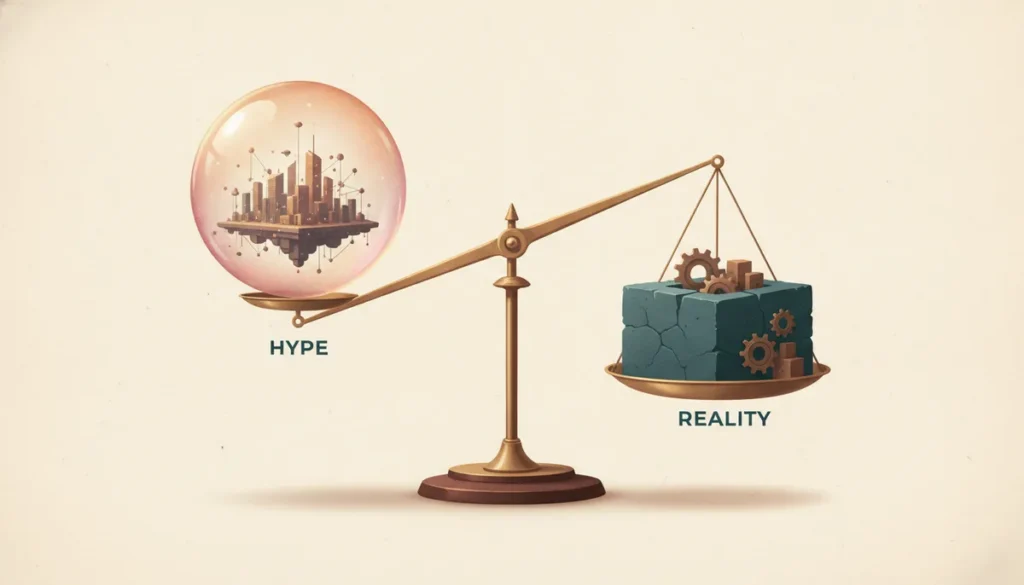
Stripped of the hype, the useful core of the idea is narrow: letting users hold assets and identity directly, and letting anyone build on open infrastructure without asking a gatekeeper first.
Whether a project labelled web3 actually removes a central point of control, or simply keeps the same gatekeepers while adopting the vocabulary.
The Digital Take is reasoning and data from the Bitcoin Digital Editorial team — context, not a buy or sell call. Not financial advice.
Sources
Frequently asked questions
Is web3 the same thing as cryptocurrency?
Not exactly. Cryptocurrency is the asset layer that often makes web3 concepts work in practice, but web3 as an idea is broader, covering ownership, identity and permissionless infrastructure generally. It is possible to hold cryptocurrency without engaging with any of the broader web3 vision, and plenty of what gets marketed as web3 is really just a token or an application built on top of these ideas.
Does using a blockchain automatically make an application 'web3'?
Not in any meaningful sense beyond the label. What matters is how much of the application's actual function, such as data storage, core logic and access, runs on open, permissionless infrastructure versus centralised servers a single company controls. Many applications that describe themselves as web3 still rely heavily on centralised components for at least part of how they work.
Is web3 safer than using traditional internet platforms?
Not automatically, and in some ways it shifts risk rather than removing it. Self-custody removes a platform as a single point of failure, but it puts security and key management entirely in your own hands, with no customer support able to reverse a mistake. Scams, poor security practices and badly built applications are all still common in web3, just as they are anywhere else online.
Why do some people dismiss web3 as mostly hype?
Because the term is frequently applied to projects that do not meaningfully change who controls what, beyond adopting the vocabulary and issuing a token. Critics point out that plenty of web3-labelled products still rely on centralised infrastructure, centralised decision-making, or both. That criticism is fair when applied to specific projects making that mismatch, without meaning the underlying idea of direct ownership is worthless.
What is a simple way to check if a project is genuinely decentralised?
Ask specifically what would happen if the founding team disappeared tomorrow. If the core application, its data and its rules would keep functioning on public infrastructure, that is a meaningful sign of decentralisation. If the product would simply stop working because it depends on a company's servers or ongoing decisions, the web3 label is describing marketing rather than the underlying architecture.
Last updated July 12, 2026

An editor with extensive experience covering Bitcoin, blockchain innovation, cryptocurrency markets, and financial technology. Passionate about delivering timely news, in-depth analysis, and educational content for the global crypto community.